Rectal bleeding, a new bowel-habit change, persistent abdominal pain or iron-deficiency anaemia needs a diagnosis before anyone can say whether surgery is necessary. By the end, you will know which symptoms require emergency care, which tests establish the cause, when medicines or colonoscopy are enough, and what to ask before planned or urgent colon surgery.
Key takeaways
- Seek urgent care for heavy bleeding, severe pain, vomiting, or inability to pass stool.
- Colonoscopy, medicines, or observation may be safer than surgery for some bowel problems.
- Planned resection treats selected cancers, strictures, diverticular disease, or persistent complications.
- Ask about the operation, stoma risk, recovery time, and alternatives before consenting.
Which symptoms need urgent assessment for a colon problem?
Symptoms needing colon surgery are warning signs for prompt assessment, not proof that an operation is required. Persistent rectal bleeding, unexplained iron-deficiency anaemia, a lasting change in bowel habits, severe or recurrent abdominal pain, fatigue and unintentional weight loss need medical review. Causes can include conditions treated with medicines, colonoscopy, dietary management or observation.
| Situation | What to do | Why it matters |
|---|---|---|
| Emergency warning signs | Go to an emergency department now | Severe abdominal distension with repeated vomiting and inability to pass stool or gas suggests obstruction; a rigid abdomen suggests peritonitis or perforation. Heavy rectal bleeding, fainting, confusion, cold sweating or other shock symptoms indicate possible uncontrolled bleeding. High fever with severe abdominal pain raises concern for perforation, bowel ischemia, severe infection or toxic megacolon. |
| Persistent but stable symptoms | Arrange a prompt consultation with a doctor or colon specialist | Bleeding, anaemia, altered bowel habits, pain, fatigue or weight loss still require diagnosis, but they do not automatically require surgery. |
Do not wait for a scheduled consultation if symptoms are rapidly worsening, the abdomen becomes swollen and tender, or you cannot keep fluids down.
Complete or worsening obstruction, perforation, peritonitis, bowel ischemia, toxic megacolon and uncontrolled bleeding can require resuscitation and urgent source control; a laparoscopic operation may not be safe when illness is severe or the bowel is greatly distended.
How doctors decide between surgery, colonoscopy and medical treatment
Doctors confirm the cause before choosing colon surgery for bowel problems. They take your medical and surgical history, review medicines and bleeding, examine your abdomen, and perform a rectal examination when appropriate. Blood tests, including a complete blood count, look for anaemia or infection.
CT of the abdomen and pelvis is used when doctors need to find obstruction, perforation, an abscess, diverticulitis, bowel-wall thickening or a mass. It also helps assess urgent complications that colonoscopy cannot safely examine.
Colonoscopy directly inspects the colon and allows biopsy. A polyp or early lesion may be removed during the procedure, so an abnormal result does not automatically mean an operation. If cancer is suspected, staging scans check whether disease has extended beyond the colon.
| Approach | What it does | When it applies |
|---|---|---|
| Surgery | Removes diseased bowel | Tissue is too large or unsafe to remove endoscopically, has invasive-cancer features, causes narrowing, or remains after incomplete removal |
| Colonoscopy | Inspects, biopsies and may remove lesions | Polyps, early lesions and unexplained bleeding |
| Medical treatment | Treats without resection | Antibiotics and bowel rest for selected diverticulitis or abscesses; medicines for inflammatory bowel disease |
| Follow-up | Monitors without immediate intervention | Findings suitable for dietary and symptom management or watchful review |
This assessment prevents unnecessary surgery. A safe alternative may be endoscopic polyp removal, antibiotics, medicines or follow-up; surgery becomes more likely when these options cannot control the disease or obtain complete, safe removal.
Which colon conditions require planned or emergency resection?
The answer to when is laparoscopic colon surgery needed depends on the diagnosis, the extent of disease and your stability. Planned resection commonly treats confirmed or strongly suspected colon cancer, a large or technically unremovable polyp, a symptomatic narrowing, complicated diverticular disease, or selected Crohn’s disease and ulcerative-colitis complications that persist despite medical treatment.
For cancer, the surgeon removes the tumour-bearing colon segment, its blood supply and regional lymph nodes—not just the visible mass. The operation may be a right hemicolectomy, left hemicolectomy, sigmoid colectomy or total colectomy, depending on tumour location and spread.
| Situation | Typical decision | Timing |
|---|---|---|
| Planned disease | Cancer, unresectable polyp, symptomatic narrowing, selected inflammatory bowel complications | Elective laparoscopic colon operation when stable |
| Complicated diverticular disease | Fistula, obstruction, stricture, life-disrupting repeated attacks or unusually high recurrence risk | Individualised elective resection |
| Immediate danger | Worsening obstruction, perforation with peritonitis, bowel ischemia, toxic megacolon, uncontrolled infection or significant bleeding | Resuscitation and urgent source control |
One diverticulitis attack, or a fixed number of attacks, does not automatically justify surgery. Elective resection weighs recurrence risk against age, other illnesses and operative risk.
Emergency surgery follows a different timetable. A very distended bowel, unstable condition or extensive contamination can make laparoscopy unsuitable; the priority is restoring circulation and controlling the source, sometimes through open surgery. A laparoscopic technique is not itself an indication.
What happens during a laparoscopic colon operation, and when can it change?
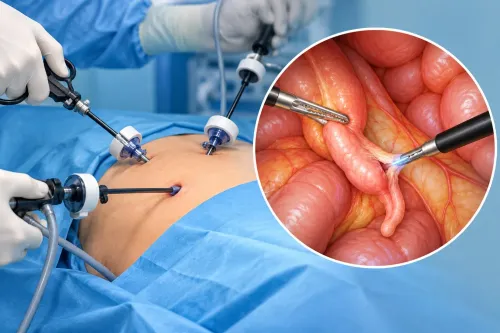
A laparoscopic colon operation begins under general anaesthesia. The team makes several small abdominal incisions, fills the abdomen with carbon dioxide to create working space, and uses a camera and instruments to free the diseased segment. The bowel leaves through a slightly enlarged incision.
The surgeon may reconnect the bowel with a stapled or hand-sewn anastomosis. A colostomy or ileostomy may be safer when obstruction, perforation, unstable illness, severe inflammation, poor tissue healing or a high leak risk makes an immediate join unsafe. A pathologist examines the removed specimen after surgery.
Laparoscopy is a technique, not a guarantee. The operation may need conversion to open surgery if the team encounters:
- Dense adhesions from earlier surgery
- A very large tumour or widespread disease
- Unclear anatomy or severe inflammation
- Extensive contamination
- Uncontrolled bleeding
- An unsafe bowel removal or an inability to complete the join
Conversion is a safety decision, not automatically a complication.
Important risks include bleeding, infection, blood clots, injury to nearby organs, ileus, later bowel obstruction and anastomotic leak. Smoking, malnutrition, steroid treatment, poor blood supply, obesity and emergency surgery increase leak risk. Treatment can include antibiotics, drainage, another operation or a temporary or permanent stoma.
What should you ask a colon surgeon in Dombivli before choosing care?
A consultation with a colon surgeon in Dombivli should turn your diagnosis into a clear decision, not an automatic operation. Ask:
- What condition has been proven, and does the colonoscopy, CT scan or biopsy support it?
- Could colonoscopy, antibiotics, drainage, medicines or follow-up safely treat it instead?
- Which colon segment will you remove? If cancer is suspected, will you remove its blood supply and regional lymph nodes?
- Is the operation elective or emergency?
- How likely are an anastomosis, temporary stoma or permanent stoma?
- What could require conversion to open surgery?
- How would you treat an anastomotic leak—with antibiotics, drainage, another operation or a stoma?
- How long will hospital monitoring last, and how much experience does the team have with laparoscopic colorectal operations?
Compare the service, not just the word laparoscopic.
| Option | What to verify | Why it matters |
|---|---|---|
| Planned laparoscopy | Pathology and CT review, anaesthesia, blood-bank access and postoperative monitoring | Confirms the extent of disease and supports safer recovery |
| Possible open conversion | Emergency open-surgery capability and critical-care support | Dense adhesions, bleeding or unsafe anatomy can make conversion necessary |
| High-risk or emergency case | Leak treatment, drainage, reoperation and stoma support | Perforation, infection, poor blood supply or emergency surgery can impair healing |
Dr Sharad Gurav Laparoscopic Surgeon - 9324545771 can relate these questions to your examination, scans and biopsy. Go to an emergency department first for obstruction, shock, perforation or heavy bleeding.
Related service
Laparoscopic Colon Surgery Laparoscopic colon surgery is a minimally invasive procedure used to treat various colon conditions, including colorectal cancer, diverticular... View service → |
Frequently asked questions
When is laparoscopic colon surgery needed?
It is considered when a colon condition cannot be safely treated with medicines or colonoscopy, or when planned removal of diseased bowel is needed. The decision depends on the diagnosis, severity, complications, overall health, and scan or colonoscopy findings.
Which symptoms needing colon surgery require urgent assessment?
Heavy or persistent rectal bleeding, severe or worsening abdominal pain, repeated vomiting, abdominal swelling, inability to pass stool or gas, fainting, fever, and unintentional weight loss require prompt medical assessment. These symptoms do not prove that surgery is necessary.
How do doctors choose between colonoscopy, medical treatment, and surgery?
Doctors use your symptoms, examination, blood tests, CT scans, colonoscopy findings, biopsy results, and response to treatment. Medicines or observation may suit inflammation or mild symptoms, while colonoscopy can diagnose disease or remove some polyps.
What should you ask a colon surgeon in Dombivli before surgery?
Ask for the exact diagnosis, reason for resection, alternatives, laparoscopic risks, possibility of open surgery, chance of a temporary or permanent stoma, expected hospital stay, recovery restrictions, and warning signs after discharge.
Keywords